


Knowledge, Experience, and Cooperation in the Service of Security!
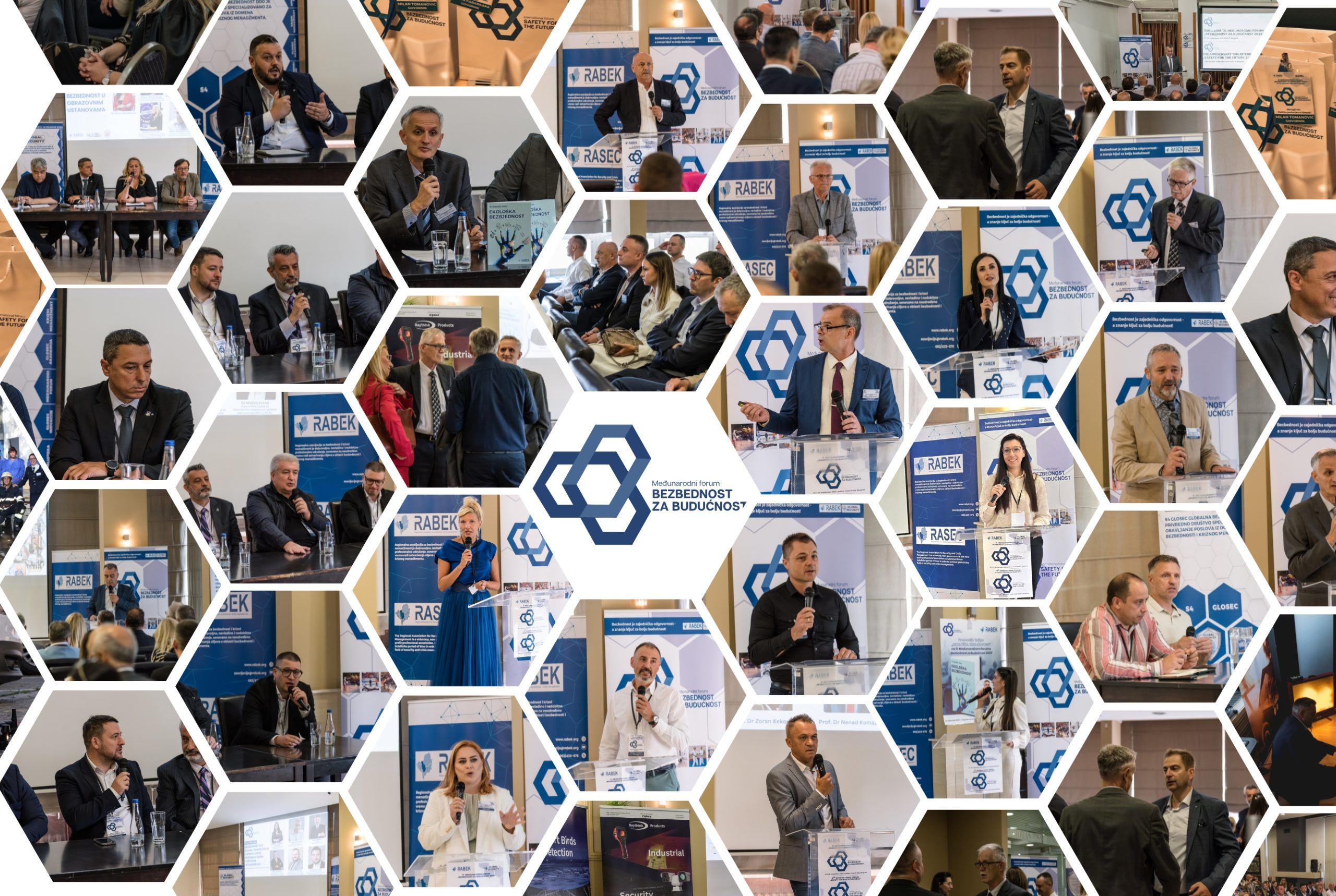
Continuous dedication to security over the past eleven years was marked by the 11th International Forum ,,Safety for the Future 2025”, held on 25 and 26 September at Hotel Srbija in Belgrade. This eleventh edition of the Forum brought together more than 100 participants from seven countries—Serbia, North Macedonia, Montenegro, Bosnia and Herzegovina, Slovenia, the UAE, and Italy—becoming a key meeting point for scientific and professional experts in the fields of security and crisis management..
The organizers of the Forum were the Regional Association for Security and Crisis Management (RASEC) and S4 GloSec Global Security, with the support of co-organizers including the Faculty of Logistics, Celje – University of Maribor, the Professional Association of the Security Sector, the Security Research Center Banja Luka, Singidunum University, Educons University, the Faculty of Occupational Safety in Niš, Adriatic University Montenegro, and the Higher Business and Technical School Doboj. TopMarketing provided official marketing support.
The 11th International Forum ,,Safety for the Future 2025” was officially opened by the President of the Program Committee and the founder of the Forum, Prof. Dr Nenad Komazec, who emphasized:
,,This eleventh year of the Forum is proof of our commitment and the collective strength of all of you who have supported us.”
Following the opening address, representatives of the co-organizers and institutions that have supported the Forum for years also addressed the audience.
After the introductory speeches by the organizers, co-organizers, and representatives of key institutions, the Forum began with a plenary lecture by Prof. Dr Aleksandar Milić, titled ,,Public Security Conditioned by Explosive Remnants of Wars and Residual Contamination.” The lecture focused on the consequences of explosive remnants of war and residual contamination, with particular emphasis on the challenges they pose to public security and the functioning of communities.
As part of the Forum, the new journal Journal for Security, Management and Engineering (JSME), published by the Regional Association for Security and Crisis Management (RABEK), was officially promoted. The journal was presented as an international platform for publishing scientific and professional papers in the fields of security, management, and engineering. It publishes original research articles and review papers that contribute to the advancement of security, management, and engineering, in accordance with an open access policy (CC BY 4.0). This means that the content is freely available to readers, and authors incur no submission or processing fees. The promotion generated significant interest among Forum participants, confirming the need for such a publication at both regional and international levels..
Interactive Program – Current Discussions in the Field of Security
During the two days of the Forum, three discussions were held, covering various aspects of contemporary security challenges.
Panel Discussion “SRPS A.L2.003:2025 – New Rules for Risk Assessment and Challenges of Conformity Assessment”
This panel brought together experts in the field of security. Speakers included:
Prof. Dr Nenad Komazec, member of the Standards Committee KS A292 “Security and Resilience”
Prof. Dr Zoran Keković, President of the Standards Committee KS A292 “Security and Resilience”
Participants actively raised questions, pointed out ambiguities, and openly discussed dilemmas related to the interpretation of specific provisions of the standard. The discussion highlighted the importance of this topic for the daily work of security managers responsible for risk assessment in the protection of people, property, and business operations.
One of the key conclusions was that the new standard offers opportunities to improve practice, but its successful implementation depends on clear interpretation and additional training for licensed security managers to ensure consistent application in practice.
Panel Discussion ,,Security 5.0: Humans, Technology, and Risk Management in the Age of Artificial Intelligence”
This panel gathered prominent experts in digital transformation, cybersecurity, artificial intelligence, and supply chain security.
The discussion was moderated by Katarina Janković, PhD candidate, and the panelists were:
Ivan Miletić – Director of Eagle Eye Media 011 and expert in integrating high-tech solutions into ICT systems for defense, security, and the public sector
Lazar Jovanović – Expert in digital transformation and artificial intelligence, Chief Digital & AI Officer at Represent System and co-founder of the WebMind platform
Dragan Pleskonjić – Founder and CEO of GLOG.AI, initiator of R&D projects including Glog.AI (Software Security), INPRESEC (Intelligent Predictive Security), vSOC (Virtual Security Operations Center), and Security Predictions – Threat Intelligence
Vladimir Surčinski – Vice President and Executive Director of ENFIT, the International Association for Supply Chain Security, which sets international standards in this field with a focus on food supply chain security
Dr Marko Krstić – Head of the Information Security Department and National Center for the Prevention of Security Risks in ICT Systems of the Republic of Serbia (National CERT), within RATEL
The discussion was both inspiring and comprehensive, ranging from theoretical frameworks and AI development to practical challenges in cyber and software security, critical infrastructure resilience, global supply chain security, and modern weaponry.
Panelists emphasized that the Security 5.0 concept places humans at the center, while technology and artificial intelligence serve as tools for proactive and predictive risk management.
The audience actively participated by asking questions and sharing dilemmas, further highlighting the relevance of the topic for everyday professional practice. A key conclusion was that while artificial intelligence offers enormous potential for improving security, its successful application depends on understanding its limitations, adhering to ethical frameworks, and maintaining continuous cooperation between technology developers and practitioners.
Expert Discussion ,,Security in Educational Institutions”
As a permanent event throughout all eleven years of the Forum, this discussion addressed the security challenges faced by schools, universities, and other educational institutions. The discussion was moderated by Dr Milica Mladenović, with speakers:
Dejan Milutinović – President of the Professional Association of the Security Sector and co-organizer of the event
Emina Beković – Head of the National Contact Center for Child Safety on the Internet, Ministry of Information and Telecommunications
Prof. Dr. Goran Vilotijević – Author of numerous works in pedagogy and didactics, with extensive experience as a teacher, school principal, and professor
Miloš Bogdanović – Publicist and researcher, author of the book “Raising the Last Generation”
The discussion focused on improving security procedures in educational institutions and reducing risks, emphasizing the need for better coordination between educational institutions, competent services, and stronger cooperation with parents.
Conference SeCMan
Scientists and professionals presented their papers on current topics in security and crisis management at the 11th International Scientific and Professional Conference ,,Security and Crisis Management – Theory and Practice (SeCMan)”.
The conference gathered participants from seven countries, with a total of 29 scientific and professional papers covering various aspects of security and crisis management.
Practical Demonstration of Models, Research Results, and Application of Capacities, Devices, and Equipment
The practical segment of the program featured a presentation by ZENEZIS, which showcased its business software solution ZENEZIS Perfect Security System for managing security operations.
The solution supports the digital transformation of security within holdings and includes:
– centralized control of all facilities, assignments, and personnel,
– automated task delegation and execution tracking,
– AI-supported risk analysis and incident prediction,
– mobile and desktop applications for operational management.
The system enables real-time monitoring of incidents and alarm states, digitalization of facilities, advanced analytics and reporting, and full support for field operatives. The demonstration clearly illustrated the potential of such solutions to improve efficiency and coordination in security operations..
Exhibition of Capacities, Devices, and Equipment
At the exhibition, Raythink preventive security equipment for strategic systems was presented, with ZODAX d.o.o. acting as the authorized representative and distributor for Southeast Europe.
Participants had the opportunity to learn about solutions such as:
PC5S4 Multi-Spectrum PTZ Camera – a dual thermal and visible system with AI recognition of people, vehicles, vessels, smoke, and fire, providing continuous day/night surveillance
SilentW-U6 Series Infrared Panoramic Camera – 360° panoramic surveillance of large areas, simultaneous detection of multiple targets, applied in the oil and gas industry and mining.
Book Promotion: ,,Environmental Security” by Slobodan Simić
The promotion of the book ,,Environmental Security” by Dr. Slobodan Simić was held on the second day of the Forum. The author and one of the reviewers, Prof. Dr Nenad Komazec, spoke about the book.
The publication is the result of years of research and pedagogical work and offers a contemporary perspective on the relationship between environmental protection and societal security. Special emphasis is placed on climate change, natural disasters, and new industrial risks as challenges requiring an integrated security approach.
The promotion opened space for understanding environmental security as an inseparable part of the overall security and crisis management system.
This decade stands as proof of our commitment and the collective strength of all those who have supported us. The eleventh edition confirmed past achievements and opened new directions for initiatives, projects, and cooperation, while strengthening awareness of the need for continuous improvement of security at all levels.
We look forward to seeing you next year, with new ideas, perspectives, and a shared vision for advancing security!
- Forum
- Events
- 12th International Scientific Professional Conference ,,Security and Crisis Management – Theory and Practice” (SecMan)
- International Exhibition Of Capabilities, Devices And Equipment In Security (International Security Exhibition 2026)
- International Conference ,,Food safety, risks and supply chain resilience”
- Practical Demonstration of Models, Research results and Application of capacities, Devices and Equipment
- Interactive Program
- Conference ,,Security In Educational Institutions”
- Tickets
- News
- Gallery
- Contact